


a case for and against constrained art-making
TEXT BY KOLLEKTIV COLLECTIVE
In the tradition of the Oulipo group, Kollektiv Collective’s Sasha Shevchenko and Pia Zeitzen explore the potential of constrained writing techniques within the framework of art and exhibition-making, observing how artists and curators continue to create even in the most challenging of circumstances.
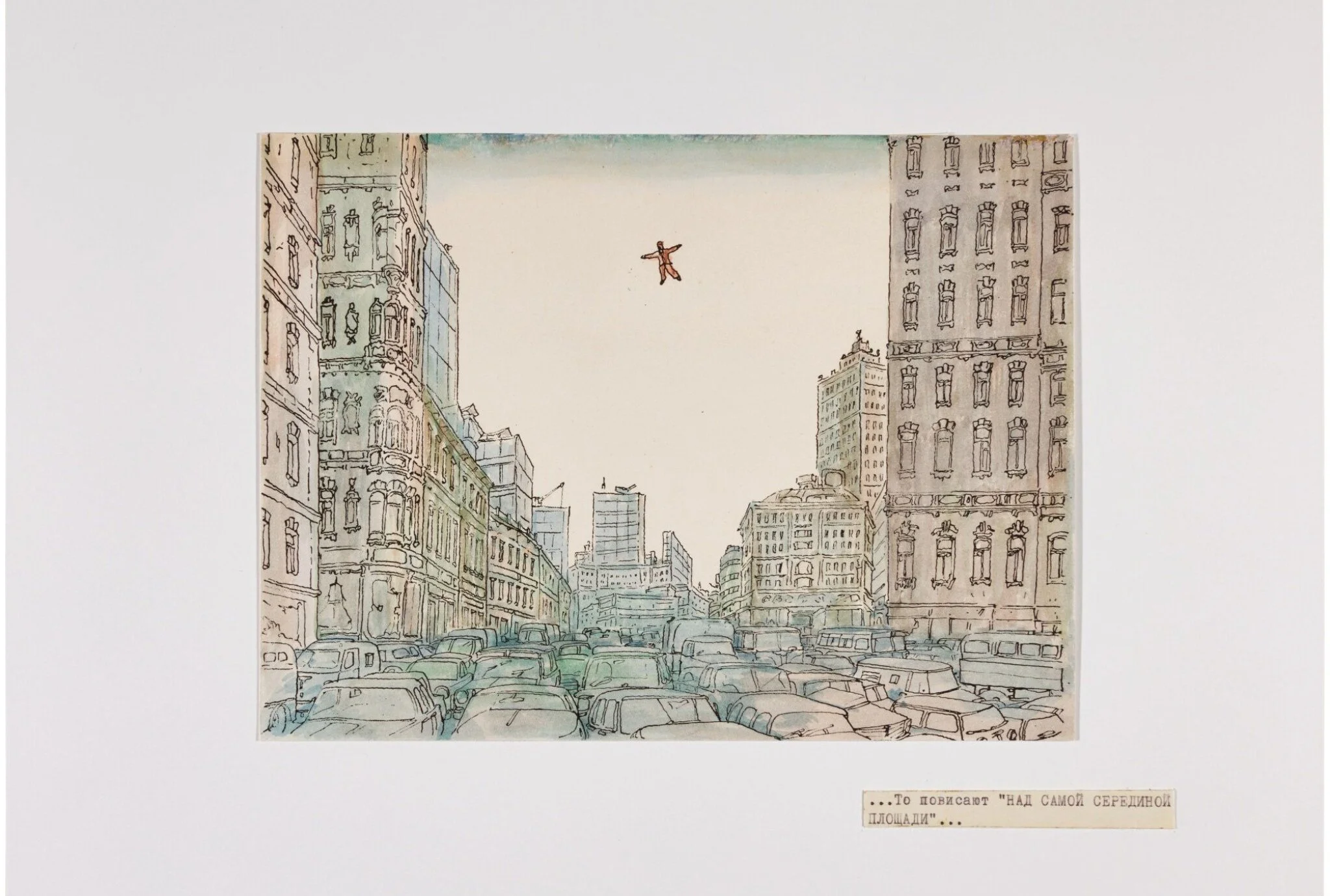
The Flying Komarov (Album of 32 Drawings) (1970s) by Ilya Kabakov.
Oulipo, an anagram for Ouvroir de Littérature Potentielle (Workshop of Potential Literature), was a group of French-speaking writers and mathematicians. Founded by writer Raymond Queneau and mathematician Francois le Lionnais in 1960, Oulipo were united by their fascination with word play. In their literary work, letters turn into symbols, words become autonomous and sentences grow into elaborate mazes. Through their exercises in self imposed restriction, commonly referred to as techniques of constrained writing, mischief is methodical and systematic. Examples include a novel without a single letter E; one completely devoid of punctuation signs; or one in adherence to ‘n+7’, i.e. replacing every noun in an existing text with the seventh consecutive noun in the dictionary. The conceptual motivation behind constrained writing can be summarised by citing one of the most prominent Oulipians, Georges Perec: "I set myself rules in order to be totally free".
Given the lack of appropriate studio spaces, finances, time and security characterising the current cultural landscape, many artistic and curatorial decisions are the result of the logistical considerations we face in developing our work. As such, artworks and exhibitions emerge from the restrictions – both the obvious and the unseen – we did not choose. Paying closer attention to that which seemingly hinders our ambition through the lens of the Oulipian method of constrained writing, restriction becomes a medium, a tool, a rebel with a cause. If we apply the method of self-imposed constraints to those of external, structural nature, can we borrow the sensation of freedom that the said method carries within?


Book cover: Life A User’s Manual by Georges Perec. The Harvill Press; New edition (17 Oct. 1988) Cover illustration is of Perec's own jigsaw puzzle (left). Plan immeuble of 11 Rue Simon Crubellier by Croquemort Nestor, 2021 (right).
The foundation of this text is the three-dimensionality of Perec’s novel Life A User’s Manual. Towards the end of the twentieth century, the architectural discourse had already turned to the terminology of literature; buildings and cities became “text” and “collages” and the concept of a unified work across literary and architectural fields now belonged to that of “textuality”. Life A User’s Manual is an example of an architext, defined as an instance where “the book and building become one”.
Perec’s novel is set in an apartment block on 11 Rue Simon-Crubellier, a fictitious street in Paris. Each chapter chronicles the objects and surfaces, happenings and histories, of the rooms, apartments and their inhabitants. At the centre of the plot is the quest of Percival Bartlebooth, an eccentric English millionaire who is one of the apartment’s residents. The quest consists of painting watercolours of ports around the world, cutting them into jigsaw puzzles, shipping them back to the corresponding port to strip all the paint, and returning the blank paper back to Bartlebooth.
Physicality and space become words in Perec’s architext, inspiring a conception of art and exhibition-making in reverse: words (as thoughts or otherwise) give way to space and physicality. In our exercise of borrowing the Oulipian method of entrapping and being entrapped by restriction as an approximation for freedom, our own version of 11 Rue Simon-Crubellier is set in 2019-present, real-life London. The residents are Plicnik Space Initiative, F.A.F Collective, Ali Glover, Shadi Al-Atallah, and ourselves [Kollektiv Collective]. The chapter-inspired narratives are dedicated to constraint and the plurality of its manifestations: as the subject matter, as the tool in artistic process, and, ultimately, as something that informs the contemporary context in which we operate. Accordingly, constrained writing turns into what can be thought of as constrained art and exhibition-making.

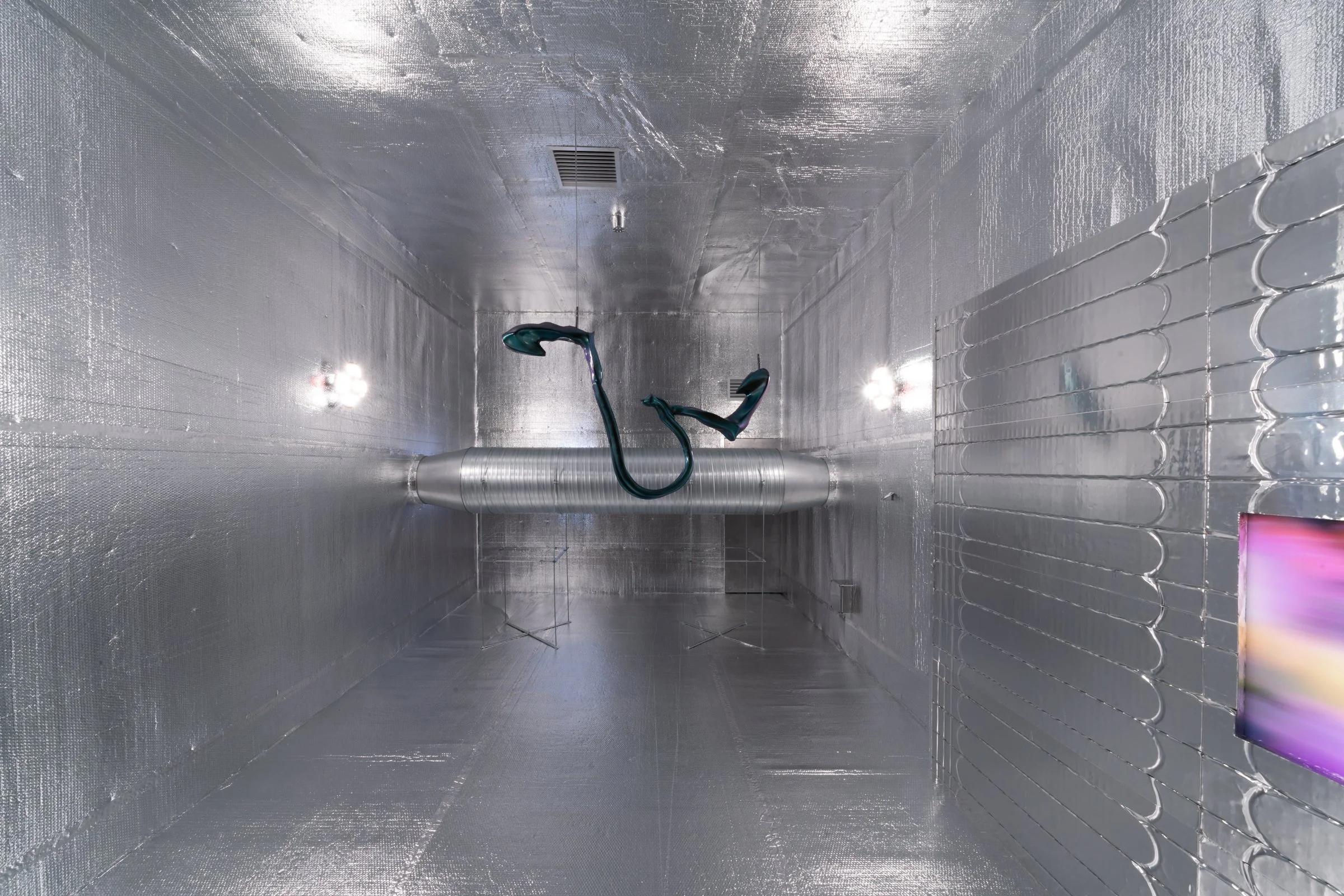
Installation view: LOG 3: Interceptor (9 November – 21 December 2024) curated by Plicnik Space Initiative. Artists: Beatrice Vorster, Szilvia Bolla, Sabrina Ratté, Evangelia Dimitrakopoulo (left). Installation view: LOG 1: 's 74th Birthday Party (6 April – 2 June 2024) curated by Plicnik Space Initiative. Artists: Eetu Sihvonen, Ilê Sartuzi, Arieh Frosh (right).
Plicnik Space Initiative is the collaborative curatorial practice of artists Amélie Mckee and Melle Nieling, who are currently running their first non-digital programme, a tripartite series in a Deptford exhibition space. Discussing their transition from the endless digital space to the four-walled gallery, the duo remark how, perhaps surprisingly, there were far fewer restrictions. So Mckee and Nieling proceeded to self-impose rules: building complex installations in the gallery space; only using props like 1980s furniture and AV equipment; and reusing sets and materials from earlier exhibitions.


Constant's New Garden (2019) by F.A.F Collective. Image courtesy of the artists (left). Installation view: All I Could See Through The Port Hole Was Glittering Dust (2024) by F.A.F Collective at SPLIT Gallery. Image courtesy of the gallery and artists (right).
Here, like in the case of Oulipo, constraint becomes a tool that exposes itself, only to be further amplified and distorted. A similar practice is executed by F.A.F Collective. Run by Ali Glover, Henry Burns and Ruairi Fallon, F.A.F respond to the physical limitations of urban sites and use available materials to create temporary, fantastical structures that entwine fictional narratives with the city landscape. From building a spacecraft in a gallery to constructing a greenhouse on scaffolding, F.A.F’s work draws inspiration from physical restrictions to reveal the structural lack of resources and access in both domestic and public settings.
Currently researching the art of wrestling, painter Shadi-Al-Atallah portrays figures in ambiguous restraints, unclear whether they are locked in an embrace or a struggle. Al-Atallah spent the last few years working in small, shared studios, sometimes just on a strip of floor space. The result is a methodical compromise – painting on the floor, in fast movement before the paint dries, using unstretched canvases to allow for efficient storage – which has eventually become foundational to their process. Though their new (and more spacious) studio at Gasworks has lifted physical constraints, the weight of unrestricted possibilities and artistic decisions created a paralysing vacuum for the artist. In the fashion of Oulipo’s constrained writing, Al-Atallah reverted to self-imposed limitations, working on a series of small-scale canvases in contrast to their previous larger-than-life works. Yet, departing from their twentieth-century literary counterparts, Al-Atallah seeks to restore the unexpected lightness of past restrictions, one where limitless choice is tamed by a comfort of pre-established direction. In resonance with Perec’s words above, Al-Atallah’s narrative makes it apparent that space and resources are but a small step towards being free.

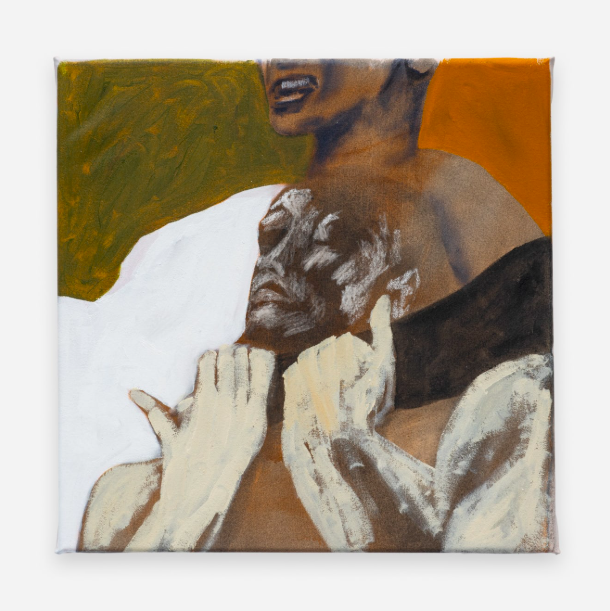
For seven days and seven nights (2023) by Shadi Al-Atallah, acrylic, pencil, ink and oil pastel on canvas, 126 x 71 cm. Image courtesy of Guts Gallery (left). With clenched fists (2023) by Shadi Al-Atallah. Image сourtesy of Guts Gallery (right).
When Kollektiv Collective was formed in 2019, there was talk of setting up a permanent, physical space to host regular exhibitions. There is an interview somewhere on the web, where we – endearing in our assurance – say that the eventual goal is to open our own space. The plan never materialised due to the lack of stability that defined that moment: budget, logistics, immigration and the impending pandemic that eventually froze time (and resources). Looking back, the cluster of restrictions turned out to be instrumental in framing our now nomadic practice. With each collaboration pushing our work further into focus, project by project, site-specific constraints continue to shape our concepts and layouts; though, unlike the Oulipo’s methods, not originally self-imposed.


Installation view: things fall apart; the centre cannot hold (30 Nov – 26 Jan 2024) at Tabula Rasa Gallery. Image courtesy of Kollektiv Collective. Photography by Gillies Adamson Semple (left). Installation view: Interlude (30 March – 7 April 2023) at Kupfer, London. Image courtesy of Kupfer. Photography by Damien Griffin.
In the same year, when Ali Glover first got to Goldsmiths, he had a clear vision to make a sculpture shaped as a water-filled barrier made out of jesmonite, only to quickly realise that A) there was no money to do it, and B) there was no time. Instead, Glover began thinking about how he can use the mould as a work in itself. What eventually (naturally) became field guide (2020) set a precedent in the artist’s practice that continues to look behind the scenes into the logistics of the artworld, labour, and urban infrastructures.


field guide (2020) by Ali Glover. Image courtesy of the artist (left). Installation view: nothing concrete (5 – 26 October 2024) by Ali Glover, curated by Kollektiv Collective at Inspection Pit. Image courtesy of Inspection Pit. Photography by Ben Westoby (right).
In 2020, Plicnik Space Initiative’s first project was meant to feature outdoor banners with printed letters and numbers, directing people to access a website. When Covid-19 intercepted its development, Mckee and Nieling instead designed a virtual spaceship. Recalling the rooms and apartments in Life A User’s Manual, the spaceship was compartmentalised into 20 distinct areas, each featuring short descriptions and floorplans, fabricating physical and spatial constraints in a seemingly boundless virtual space. Responding to an open call encouraging submissions to be exhibited in the spaceship, an artist sent through a picture of a yurt in a North American desert. In the aftermath of the pandemic, it became evident that the restrictions on services and access to public space had led towards a critical investigation of the possibilities of digital versus physical space, resulting in novel propositions on sharing and viewing art online – even yurts in spaceships.


D02.2 spaceship courtesy of Plicnik Space Initiative, designed by Amélie Mckee, rendered by Ma Baocheng (left). Turnkey Palette Engine Dream by James Jessiman. Image courtesy of the artist (right).
But constrained art-making is not unique to the present moment. Take Ilya Kabakov’s albums of the early 1970s, which were uniquely exhibited in Western galleries in boxes, carrying the memory of the artist’s spatially-restricted apartment and his role in shaping 1960s Moscow Conceptualism. Or Belkis Ayón, whose hauntingly beautiful collographs were, in material terms, developed in response to the Cuban shortage of art supplies after the collapse of the Soviet Union. Or Hélio Oiticica working with pigment in place of highly expensive, imported paints, to experiment with its light sensitivity, allowing colour to transform in real time.

La cena (The Supper) (1991) by Belkis Ayón. © Belkis Ayón Estate. Courtesy of the Belkis Ayón Estate and David Castillo. Photo: José Figueroa.
§
In writing this, we wonder whether the endeavour of looking back at the point when restriction ruined the original plan is an act of rationalising, denying space for the instrumental role of chaos in shaping one’s path, an activity Georges Perec was so critical of. But perhaps we can resort to Perec’s go-to antidote for rationalisation – failure. To attentive readers, the apartment block of Life A User’s Manual is structured like a chessboard, and the chapters’ order mimic the way the knight tours the board. The chapters’ narratives all take place simultaneously, in a single moment that occurs after Bartlebooth’s death, having failed to finish all 500 puzzles. Failure is a prominent theme in Perec’s novel, both in content and form, for the knight’s tour remains incomplete: the cellar’s chapter, the very foundation of the building, is missing. Like Bartlebooth’s unfulfilled project, Life A User’s Manual failed in itself, only that here, failure is by design, in a subtle critique of the totalising architecture (e.g. Haussmannisation) that celebrated order and rejected the inherently uncontrollable and chaotic nature of human life.
While our failure to adhere to the original plan is not by design, it still functions as a remedy to the detrimental illusion of order. As seen in both contemporary and historical examples, the mess we are in is what forces us to adapt, shaping our protest in the process. Even if this essay is an expression of coping with ambition, time and again being forced into sensible shapes, an articulation of cause and effect remains if not perfectly human, then perfectly acceptable. Whether this exercise is fruitful or futile is irrelevant: the line between the two is arbitrary, as Bartlebooth’s fifty-year long self-sabotaging quest suggests.
What we also learn from Oulipo and witness in the practices of some of the residents above, is that constraints can give way to freedom. So far, we have omitted a definition of exactly what this freedom entails, making the lack of this text’s very foundation its failure, the missing cellar in our version of 11 Rue Simon-Crubellier. Whether this is purposefully designed, or, again, is the result of external conditions charging freedom with a utopian sentiment, will remain unresolved; as a nod to Perec’s commitment to unsolvable puzzles, but also as an inclination towards open-ended definitions. To make sense of the irony of approximating freedom (the kind constrained art and exhibition-making allows us) in the lack of freedom (the kind of the proverbial meaning of the word) that has informed our practice in the first place, we revert: is the difference between the rules we set ourselves and the rules that were set out for us fundamental enough to undo this promise? We hope to answer in the negative, with additional thanks to the fucked-up world for coercing us into making finer art.