

Renée Levin
Renée Levin

A Conversation with Renée Levin
TEXT BY Glimpse Magazine

Renée Levin. Photo by Thom Fortune for Malibu Beach Inn
Renée Levin transforms ordinary objects into quiet meditations on emotion, memory, and the orderly patterns of the natural world. Through careful restraint and scale, her paintings invite viewers to slow down, reflect, and feel the granular contours of delicate objects like pearls, shells and flowers, while also luxuriating in their monumental presence.
Levin drew inspiration from the property and the surrounding area impacted by the 2025 Palisades Fire. There, she foraged for local wildflowers and began learning more about them, marveling at their forms and discovering their symbolism—ultimately inspiring the subject of the commissioned work.
In this conversation, Levin shares how impermanence, intimacy, and subtle gestures of form shape her practice and the emotional resonance of her work.
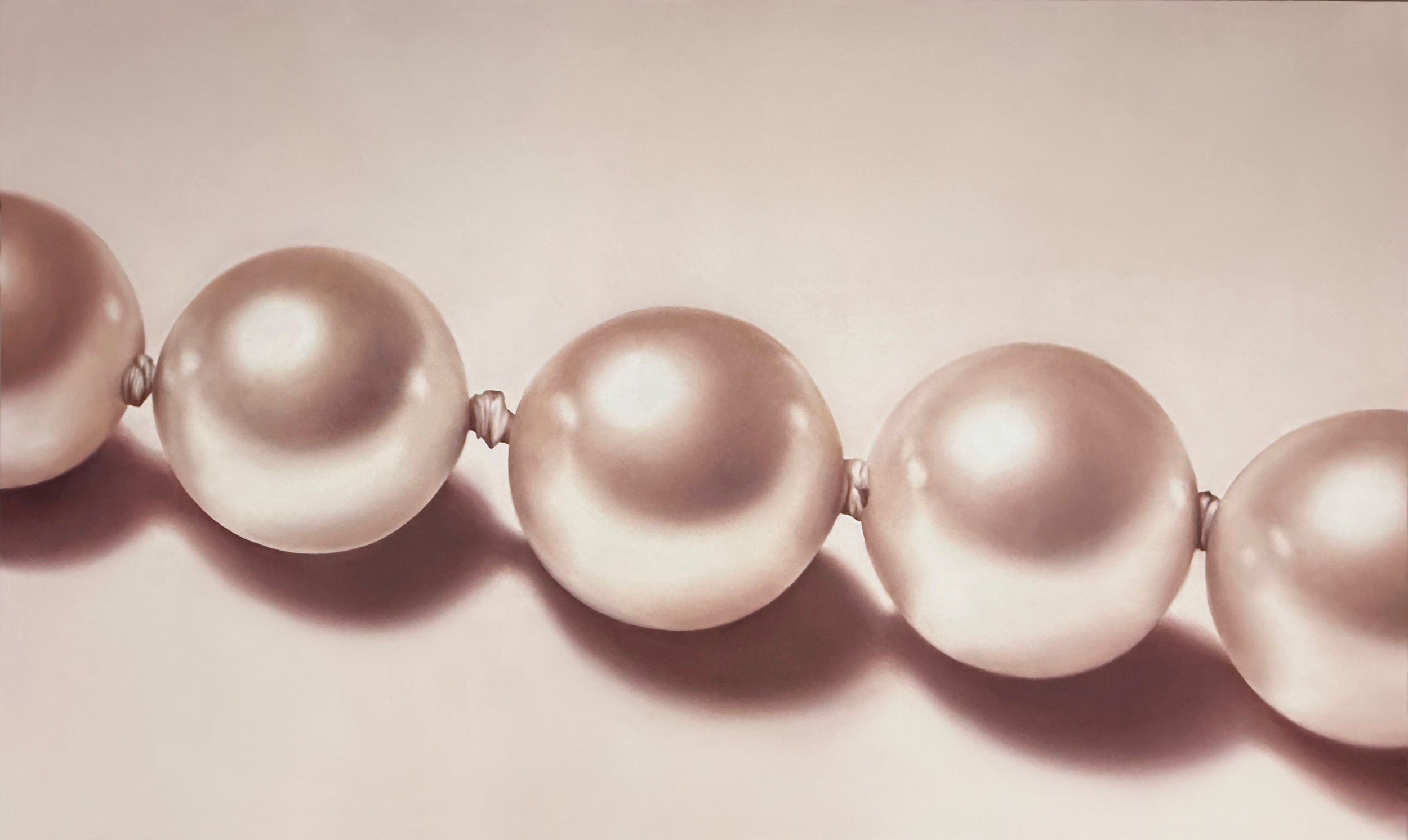
Renée Levin, Blushed, 2026, Oil on panel, 36x60 inches
How does constraint inform your paintings?
The constraint in my work is a deliberate choice, not a limitation. My practice is a meditative process that gives me the space to take time and slow down. I bring this sense of calm to each work through techniques such as palette choice, negative space, carefully curated compositions and movement created through visual texture. These choices allow for a quiet intensity, both emotionally and figuratively. The paintings hold feelings through restraint, through what is withheld. It’s actually where the emotional intensity lives. Outside of my studio, the world often feels fast-paced, loud, and focused on immediate results, sometimes at the expense of emotional depth. I feel fortunate to have this sacred space where I can do the opposite.
How do you decide when a particular object (pearls, shells, flowers, etc.) feels right to become the subject of a painting?
Above all, something about the object has to bring me joy. It must speak to me and excite me enough that I want to spend time painting it. Sometimes it’s the way sunlight reflects off a surface, a striking pattern, or even a small imperfection or flaw. These are the details that capture my attention and inspire me to interpret and share them with an audience through my work.

Renée Levin, Miss Nautilus No. 03, 2025, Oil on panel, 40 × 40 inches
By enlarging these small objects, what do you hope to discover?
“BY TAKING MINUSCULE OBJECTS AND ENLARGING THEM, I PLACE THEM ON A PEDESTAL, WHERE THEY BECOME ALMOST MONUMENTAL.”
By taking minuscule objects and enlarging them, I place them on a pedestal, where they become almost monumental. I want to celebrate them, their perfections and imperfections. In my new collection, I enlarge and crop some of the floral imagery to the point of abstraction. At a large scale, they begin to act as stand-ins for emotion. The ruffled edge of a tender lisianthus petal or the velvety surface of a rose petal, these textures allow the floral forms to become vessels of emotion. Ultimately, I want the work to give the audience permission to be vulnerable, to slow down and truly feel.
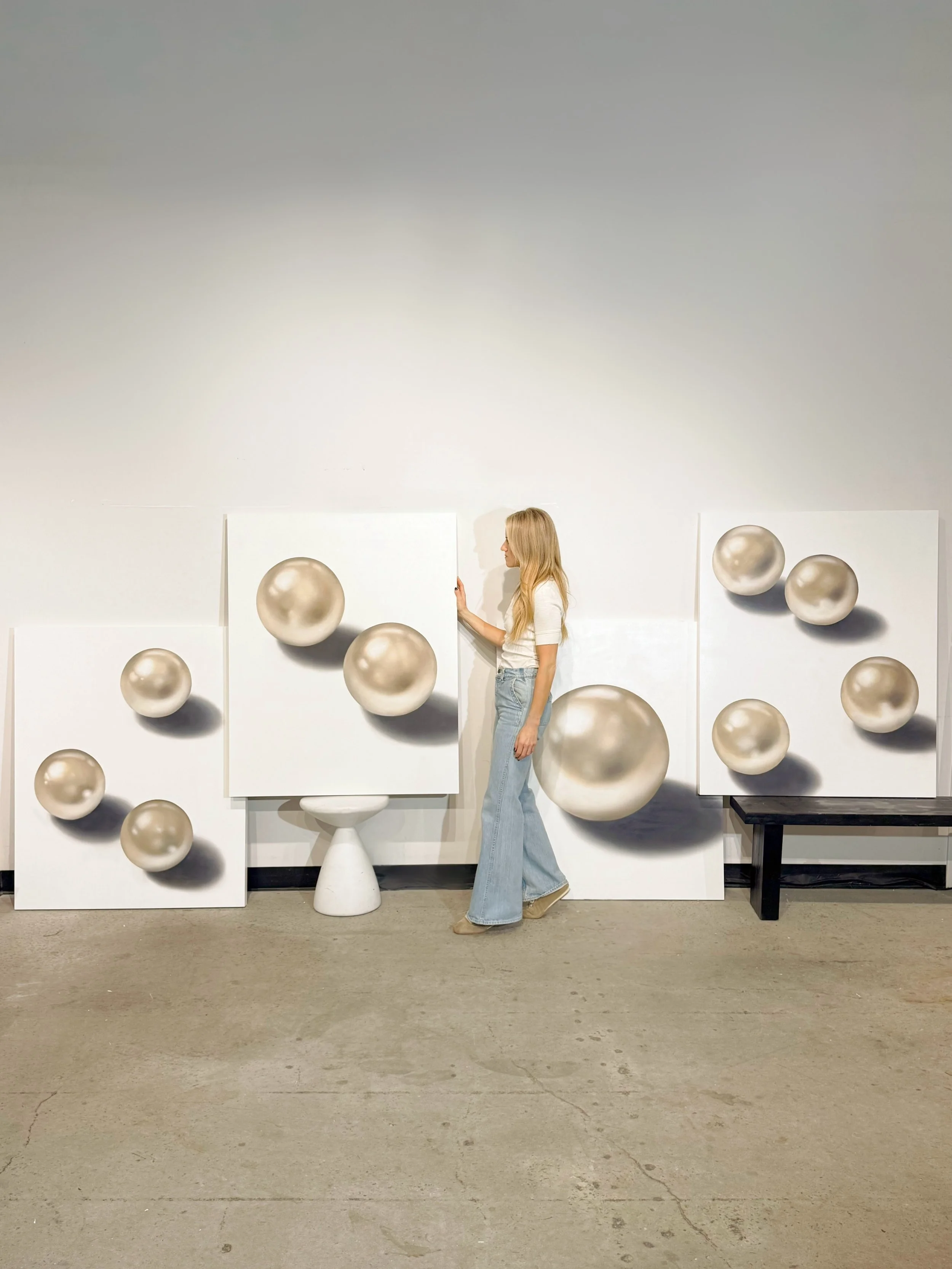
Renée Levin in studio, courtesy of the artist
Do you think of symbolism at all in your work?
The objects I paint are nature’s gifts: the repetitious patterns of petals that form a flower, a luminescent pearl slowly forming within an oyster, or the intricate pattern on a feather or a shell. They carry a sense of wonder that feels almost sacred. When you spend time looking closely at these forms, it becomes difficult not to think about a sense of godliness, of creation, of a higher power.
“THEY CARRY A SENSE OF WONDER THAT FEELS ALMOST SACRED. WHEN YOU SPEND TIME LOOKING CLOSELY AT THESE FORMS, IT BECOMES DIFFICULT NOT TO THINK ABOUT A SENSE OF GODLINESS, OF CREATION, OF A HIGHER POWER.”
The natural world holds an extraordinary level of order, beauty, and complexity within even the smallest forms. When I paint these objects at a larger scale, I am inviting the viewer to slow down and encounter that quiet miracle more intimately. In this way, the paintings become a kind of meditation on creation itself. They create a space for reflection for my audience to sense something larger than themselves, whether they call it nature, spirit, or a higher power.

Renée Levin, Before Bloom, 2025, Oil on panel, 48 x 36 inches
Do objects carry their own meaning, or do we inscribe them with our own?
I paint inanimate objects that are, in many ways, expressionless, therefore I have the ability to project and express emotion through my subjects. The objects themselves are quiet and neutral, but through scale, composition, and texture they begin to carry feeling. In this sense, they become vessels for emotion within the work. I’m interested in the space between what the object inherently is and what we bring to it as viewers. While I may approach a flower, shell, or pearl with an emotional intention, the meaning is never fixed. My hope is that these forms act as subtle triggers, allowing viewers to project their own feelings and memories onto them.
Flowers are central to your new work. Do you approach them differently in comparison to your previous subject matter or how flowers have traditionally been treated?
I do approach flowers differently from my previous subject matter, as they feel more emotionally charged. There is a softness to them that allows for both stillness and intensity at the same time. They are also a thread to my past, a reflection. They become more than simply subjects; they become carriers of memory and the emotions that accompany those memories.

Renée Levin. Photo by Thom Fortune for Malibu Beach Inn
What can you tell us about your new painting created in Malibu, California?
“IN THE AFTERMATH OF THE FIRES, WILDFLOWERS WERE THE FIRST TO BLOOM AND COVER THE LAND WITH THEIR BEAUTY, AS THEY THRIVE IN ASH.”
During my residency in Malibu, I was touched by the unavoidable devastation from the Palisades Fires just over a year ago. However, it was hard not to notice the lush greenery and wildflowers that swooped in amongst the debris. In the aftermath of the fires, wildflowers were the first to bloom and cover the land with their beauty, as they thrive in ash. One such wildflower, the morning glory was scattered on vines growing in the foothills along the PCH as well as inland in the brush of the mountains. She Resurrects is a painting of a dainty morning glory, a symbol of hope, resilience, and renewal. I was compelled to paint her and the message she brings.
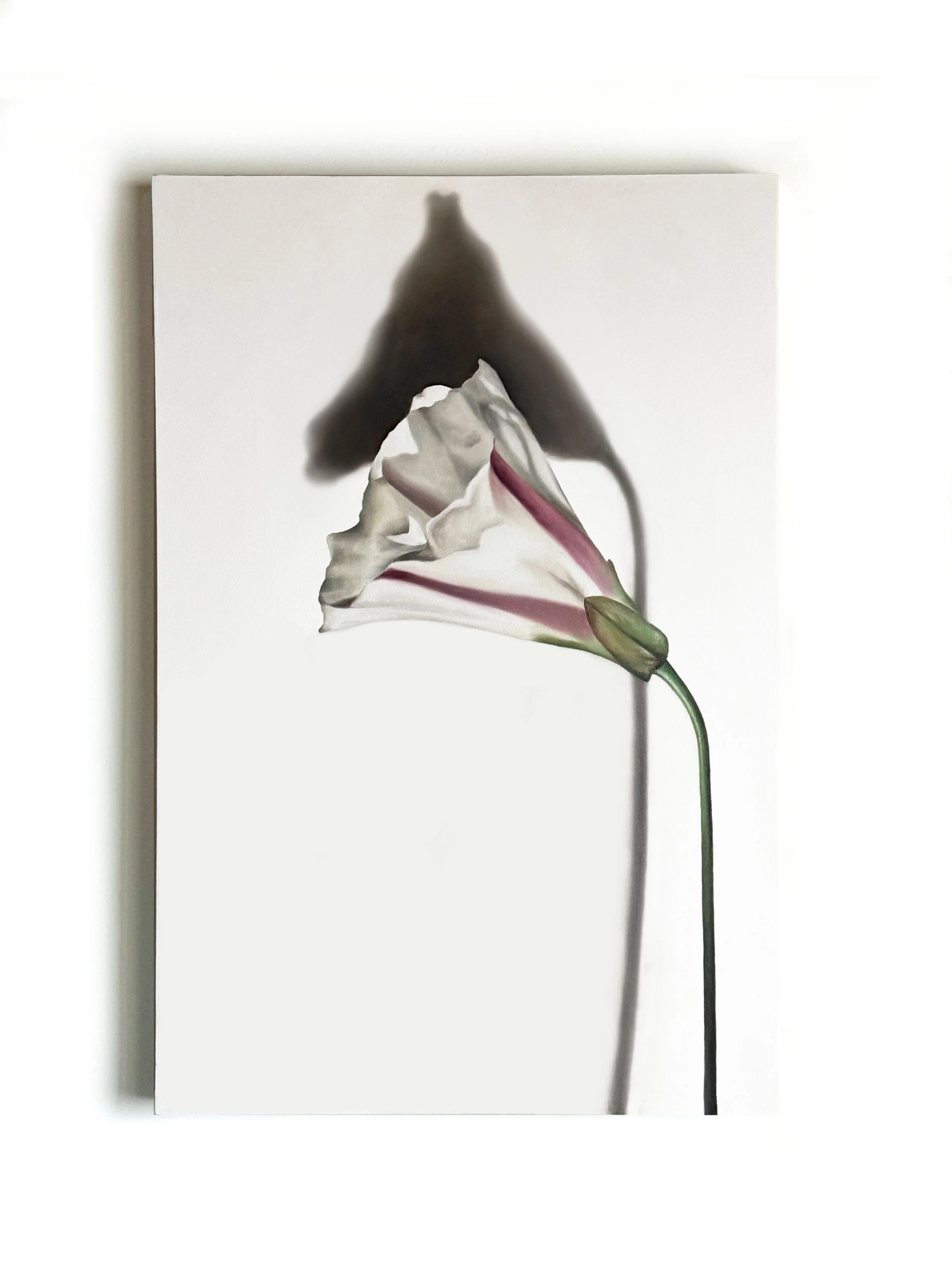
Renée Levin, She Resurrects, 2026, Oil on panel, 36 × 24 inches