


Marine One
Marine One
A Conversation with Marine One
TEXT BY Katrina Nzegwu
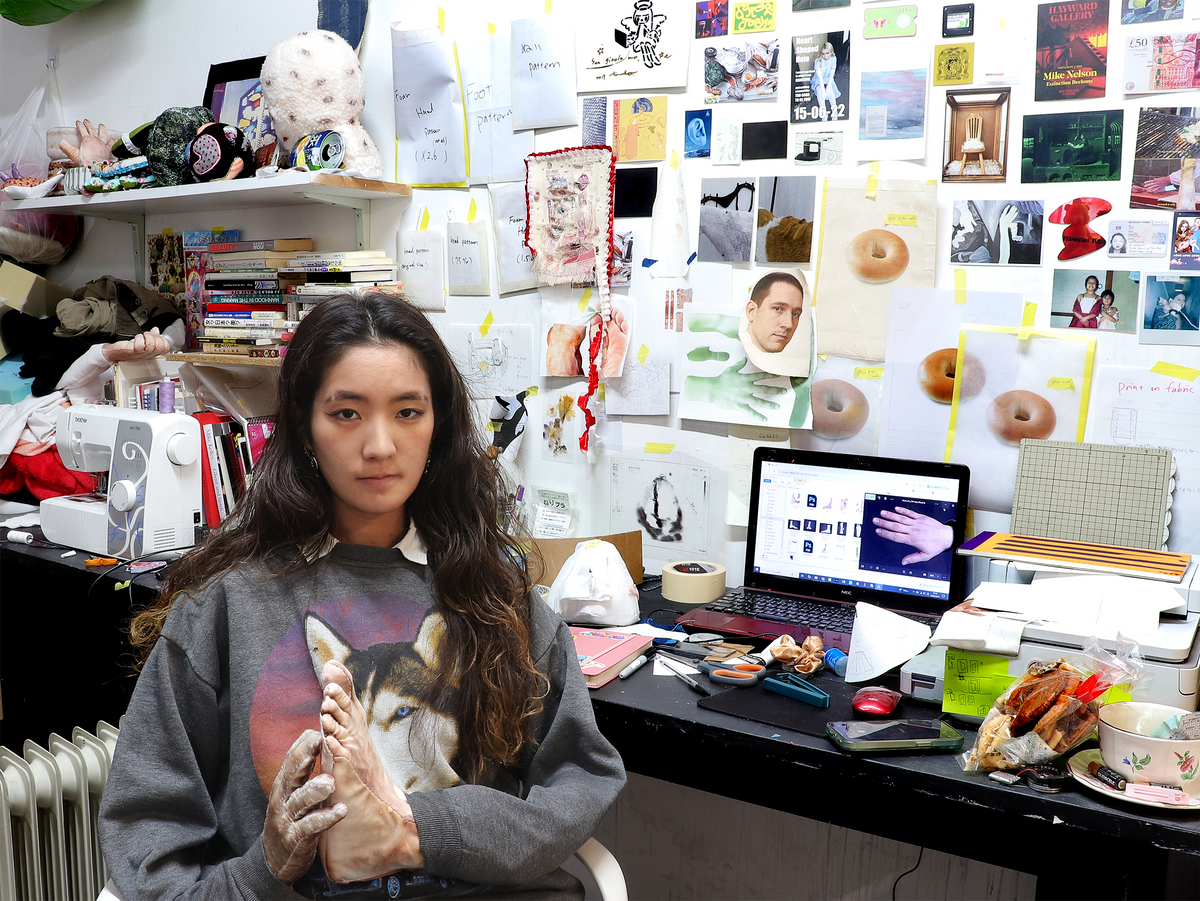
Marine One Portrait. Courtesy of the artist.
‘I like work that not only has a visual impact. I like when art makes you think.’ So says the artist Marine One, whose work does exactly that. Across textiles, sculpture and installation, the artist combines popular symbols with personal memories to create works that feel at once remarkably proximate and conceptually estranged.
That tension between the familiar and unfamiliar runs through both Marine’s practice and her life. Having grown up in Japan before a brief stint in New Zealand as a teen, studying in Milan and completing her MA at London's Central Saint Martins, Marine has spent much of her life navigating different cultures. Of the four locales in which she has resided, Marine deems Italy to have had the greatest bearing on her artistic identity. ‘I think staying in Milan was a very crucial moment in life. I was so self-conscious of my difference – I struggled to fit in with the culture, to become less visible.’
Italy was also where she encountered Lucio Fontana, Maurizio Cattelan, and the architecture of the Collezione Gori in Pistoia, encounters that sparked a lasting interest in spatial experimentation, and the capacity of installation to alter the viewer’s perception of space.
Moving to London marked another turning point. ‘I was much more comfortable with myself in London. It gave me space to think deeper about my identity.’ While her undergraduate work explored feminism in Japan, her MA became more autobiographical. She began incorporating family photographs and archival imagery, allowing her own experiences to take centre stage. ‘I felt more confident expressing things from my personal perspective.’
Today, Marine’s work explores the persistence of misogyny across both Japanese and Western cultures. Rather than offering direct criticism, her works invite viewers to question the cultural symbols and traditions that quietly reinforce those ideas.
*
Much of Marine’s work resides in the liminal space of the uncanny valley, where the unsettling is often offset by humour. Each of her works contains an element of impracticality, drawing on humour as a way of exploring memory, and the subtle frameworks that shape both self-perception and the ways we see other.
The references contained within Marine’s works are a blend of those sourced from online repositories, and photos from familial archives. This intermingling of the personal and generic endows otherwise neutral images with emotional charge.
Such notions of belonging, convention and cultural identity permeate Marine’s oeuvre, perhaps most clearly in (not) My Uniforms (2026). The work brings together uniforms associated with different stages of education and working life. Composed of A4 sheets of canvas, assembled to present a single figure, the work deliberately reveals the seams of its construction. Produced using her home printer, its low-resolution aesthetic recalls Hito Steyerl's concept of the "poor image", while reinforcing Marine's interest in socially constructed identities. The work bears Marine’s preference for displaying the technique of assembly, where the sutures between each panel remain visible.
Though the referenced uniforms signify the institutions Marine inhabited, they themselves were never worn by Marine. She depicts the male counterparts to those she herself donned, thus framing the work as a retroactive act of reclamation: an exploration of what she might have chosen to wear, had that choice been available.
The generic nature of the universal uniforms is subverted by the superimposition of Marine’s own visage, aged 10, onto the computer-generated body. Captured reluctantly by her parents at a school sports day, her petulant expression brings to the fore a simmering tension that subtly reinforces the work's challenge to institutional conformity.
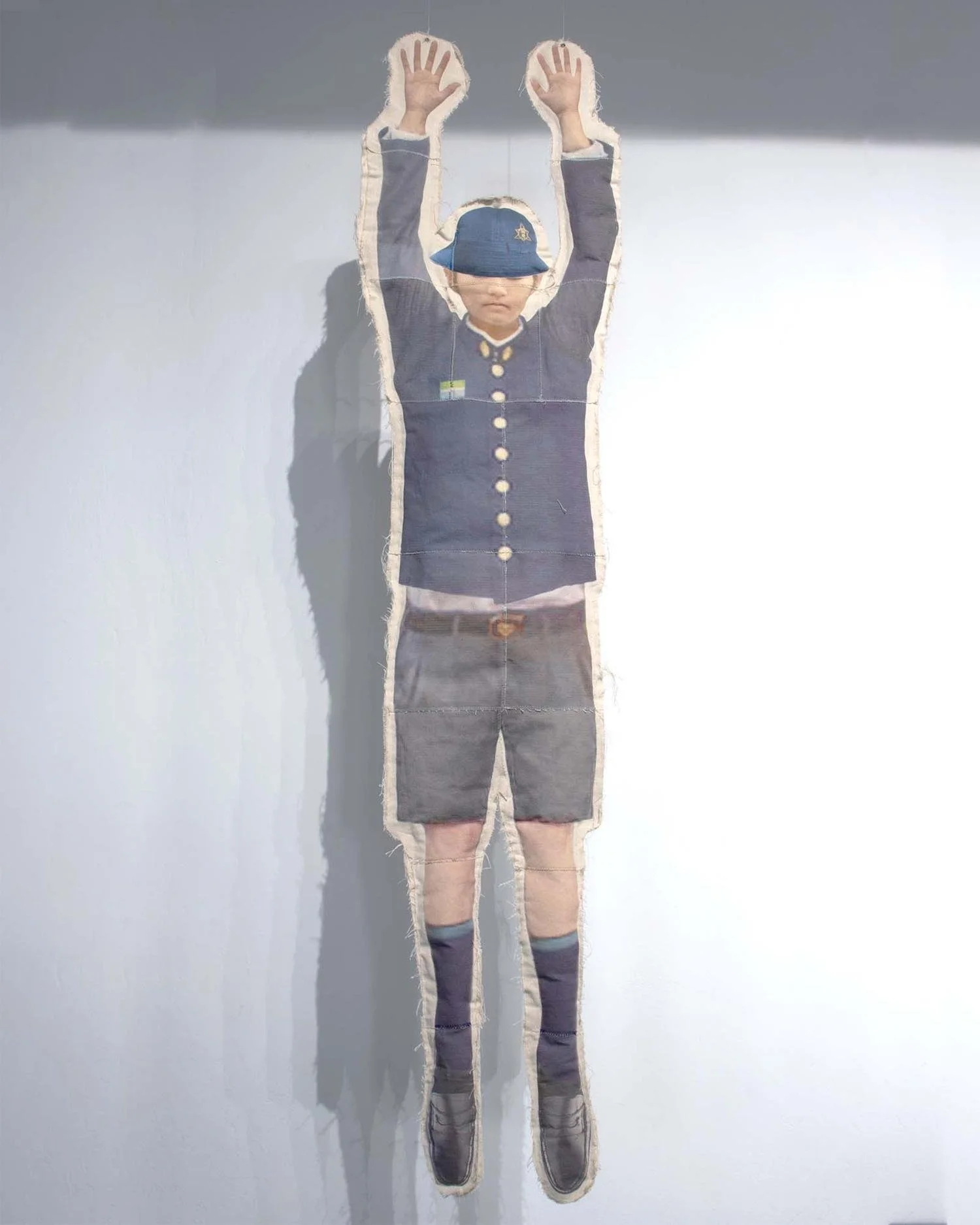
Marine One, (not) My Uniforms (2026), print on fabric. Courtesy of the artist.
(not) My Uniforms asks how a sense of belonging, identity and behaviour might be shaped by an item of clothing, foregrounding the interconnection between personal subjectivity and structural signifiers. Marine tells me, ‘the concept of wearing a uniform is different in Japan, it's stricter – there's no room for personalisation or customisation. Girls can’t wear trousers, or accessories; your hair has to be tied at a certain height.’ The work imagines how identity might be reconstructed, by challenging the social codes embedded within everyday objects such as clothing. Its fragmented construction reflects the mosaic of experiences and external influences that shape our understanding of identity, and the ways ideas of masculinity and femininity are collectively formed.
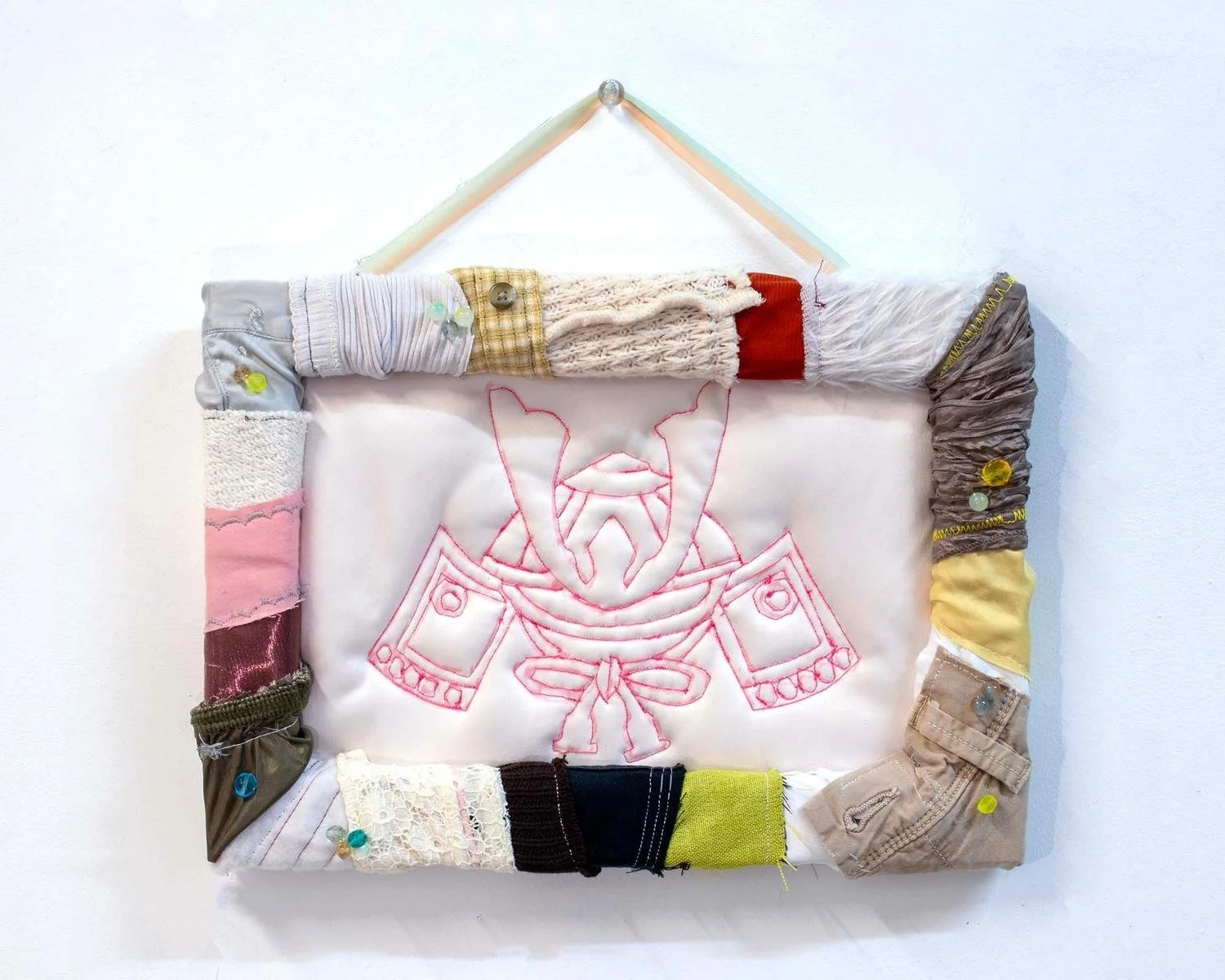
Marine One, 5th May (2026), Fabric, toystuffing, beads and ribbon on wooden stretcher. Courtesy of the artist.
The role of the masculine and feminine within Japanese culture is further explored within the companion works 5th May (2026), and 3rd March (2026). The latter date refers to Kodomo no Hi, or Children’s Day: a national holiday characterised by the display of aspirational, symbolic objects that project care and resilience into a child’s future, such as Koinobori (carp streamers) and Kabuto (samurai helmets). During the Edo period (1603–1868), the festival gradually became associated with boys' growth and success: ‘leading up to the day, all the adverts, and merchandise are targeted at boys.’ Within the composition, Marine centres the image of the kabuto; embroidered, it is stripped of volume and de-ritualised. The soft fabric from which the work is constructed – made from scraps of tents and used clothing — undercuts the rigidity associated with conventional ideas of masculinity, probing contemporary relationships to tradition. As Marine explains, she is interested in the ‘overlooking of the connotations behind the symbols used in ritual practices.’
Its companion work, 3rd March, evokes the annual festival Hinamatsuri (Girls’ Day) celebrated for the health, prosperity and happiness of girls. Traditionally, the festival celebrates young girls, in particular s the important childhood stages of ages 3 and 7. The symbolism of the festival differs markedly from Children's Day. Instead of the warrior's helmet, households display ornamental dolls depicting a bride and groom. Originating in the Heian period (794–1185), the dolls continue to evoke traditional ideals of marriage and feminine fulfilment.
At the centre of 3rd March, the Obina (male doll) stands alone. Physically and conceptually divorced from his partner, his solitude is a rare sight. By disrupting the familiar pairing, Marine gently unsettles the traditions the work references. The fact serves to highlight the fragility of ritual customs when removed from their original context, suggesting the possibility of reframing similarly derogatory aspects of cultural scripts.
*
Considering the centrality of Italy to the development of Marine’s practice, it is apt that our conversation takes place amidst her completion of the Bienno Borgo degli Artisti residency in the medieval village of Bienno, in Lombardy’s Camonica Valley. Residing in the Casa Valiga (“House of Artists”) for three weeks, alongside three other artists, Marine is developing an interactive installation, intended to take the form of a large, wall-mounted textile, surrounded by hand-made, small, plushie objects. ‘I’ve been asking people about items that they think of as signifiers of their identity’, she tells me. Interviews with local people, tourists and the other residents have generated such material as a corn thresher, iron hammer, Camel cigarettes and a bay horse; a camper van driven across numerous country lines, a Buddha-shaped stone, and a cooking knife. Using a mechanism of ferrous sheets and magnets, she explains: ‘the idea is that the hanging textile will be a net-like structure, and people can take these objects and attach them where they like.’
The residency also reflects Marine's growing focus on textiles in recent years. Initially shaped by the practical realities of studio space, the shift has become an important part of how she thinks about making work. The harsh reality of the psychosocial effects of the stereotypes she explores, are juxtaposed with the soft tactility of her fabric creations. Rather than becoming didactic, her sculptures invite viewers to engage with difficult ideas through touch, humour and curiosity.
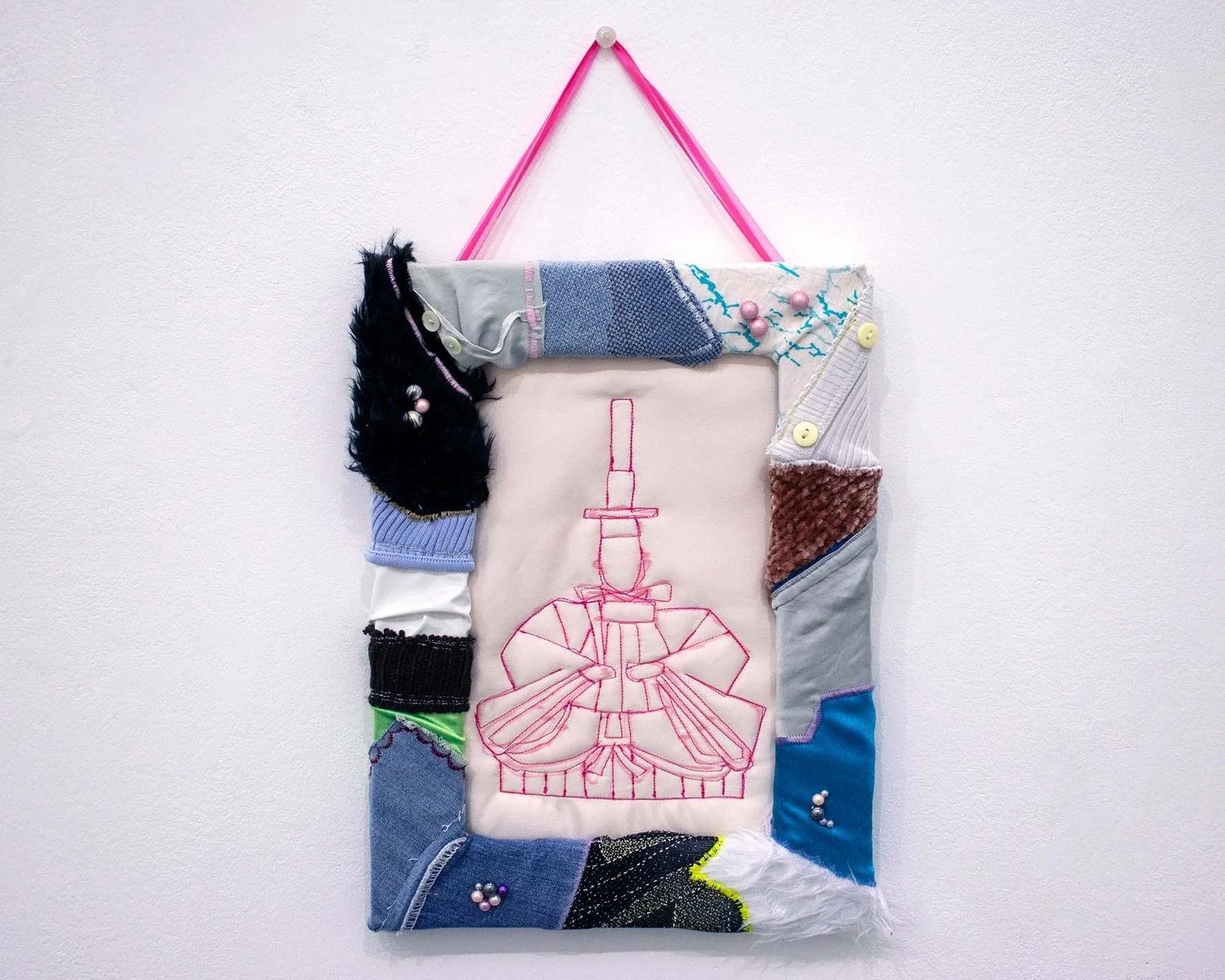
Marine One, 3rd March (2026), fabric, toystuffing, beads and ribbon on wooden stretcher. Courtesy of the artist.
I ask her if this recourse to the hand-made textile is purposeful – perhaps a response to the increasing dominance of digital technologies and AI. She resists this. Marine is quick to point out that she isn't opposed to new media, occasionally using AI herself to generate reference images. What is important, she tells me, is what happens when those digital references become physical objects. ‘The final work may still retain the essence of digitality, but I’m most interested in what emerges from the mixture of techniques.’
That dialogue between the digital and the handmade mirrors a broader tension that runs throughout Marine's work: between recognition and distance; personal memory and collective celebration. She invites the audience to participate in the processing of her memories, engendering a covert confrontation, allowing the works’ meanings to shift from person to person rather than offering fixed interpretations.
This is particularly evident in her use of symbols that are immediately recognisable within Japanese culture, but carry very different associations for audiences elsewhere. She tells me, ‘I don’t think I would be using as many references to Japanese culture, if I was making work for a Japanese audience. If I moved back to Tokyo, I’d probably start using UK-based references!’ In this admission rests the crux of her practice: Marine is not interested in works that are easily read within their geographic context; the whole point is to provoke and, in doing so, generate new associations.
Marine’s art is engaged in the sowing of the seeds of new ideas, diverse ways of being, seeing and understanding. Her proclivity for interaction is a symptom of a desire to stimulate memory and memorability, intrigue and impact. Rather than seeking a single 'correct' interpretation, Marine leaves room for multiple readings. It is in those layers of meaning — and in the associations each viewer brings to the work — that her practice is at its most compelling. Again, as she puts it: ‘I like when art makes you think.’